Alternating Current Machines by M.G. Say
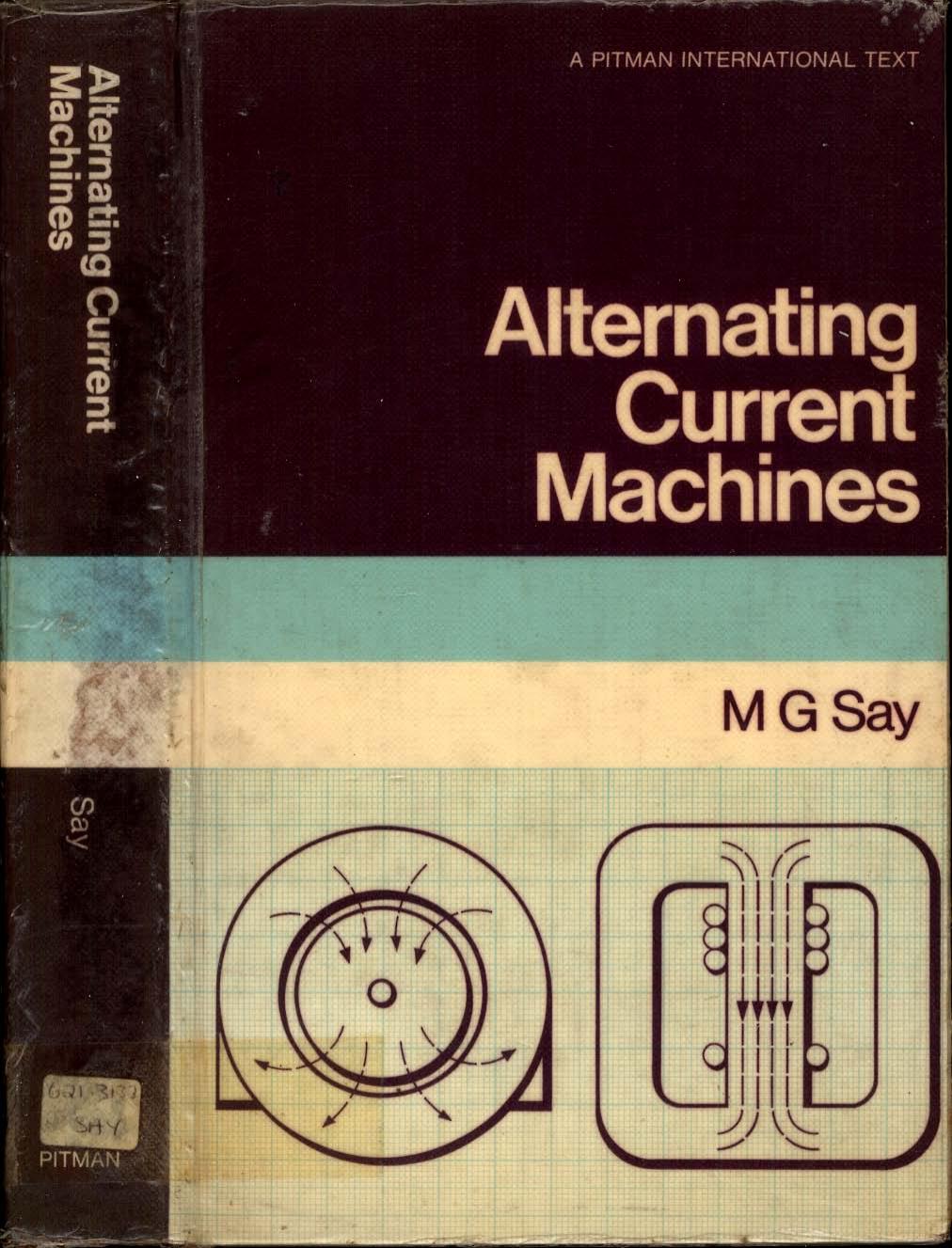
Author:M.G. Say
Language: eng
Format: epub, pdf
Tags: Electronics, Electrical Engineering, Transformers, Magnetic Circuits, Windings, Induction Machines, Synchronous Machines, AC
0-5 10 1-5
Output power (p.u)
8.18 Motor performance curves.
2-0
more rapidly, until at maximum load (about 100% overload) the current may be about three times its full-load figure, at a power factor in the neighbourhood of 0.7. At this stage a small increase in overload will cause the motor to stop suddenly. The current will rise to e.g. five times rated full-load value, the torque will be small, and the power factor lower, 0.2-0.4. The machine will not restart until the load torque has been reduced below that available at starting. The rating of a motor must be reckoned in relation to its pull-out or stalling (maximum) torque, a usual relation of maximum to full-load torque being 2:1.
A typical set of characteristic curves over the complete range is given in Fig. 8.18.
The efficiency and power factor at rated load depend on the size and application, and particularly on the nominal speed nx = f/p (r/s) or 60 f/p (r/min) for a machine with p pole-pairs and a supply of frequency/. Because of less effective use of material and greater leakage inductance a low-speed machine is heavier, less efficient and more reactive than a fast machine. The figures below compare the data for a 5 kW machine at various speeds, and a range of cage and slip-ring machines.
5 kW 50 Hz 3-ph Cage Motor
Download
This site does not store any files on its server. We only index and link to content provided by other sites. Please contact the content providers to delete copyright contents if any and email us, we'll remove relevant links or contents immediately.
| Automotive | Engineering |
| Transportation |
Whiskies Galore by Ian Buxton(42078)
Introduction to Aircraft Design (Cambridge Aerospace Series) by John P. Fielding(33174)
Small Unmanned Fixed-wing Aircraft Design by Andrew J. Keane Andras Sobester James P. Scanlan & András Sóbester & James P. Scanlan(32835)
Craft Beer for the Homebrewer by Michael Agnew(18283)
Turbulence by E. J. Noyes(8110)
The Complete Stick Figure Physics Tutorials by Allen Sarah(7422)
The Thirst by Nesbo Jo(7002)
Kaplan MCAT General Chemistry Review by Kaplan(6985)
Bad Blood by John Carreyrou(6669)
Modelling of Convective Heat and Mass Transfer in Rotating Flows by Igor V. Shevchuk(6493)
Weapons of Math Destruction by Cathy O'Neil(6362)
Learning SQL by Alan Beaulieu(6334)
Man-made Catastrophes and Risk Information Concealment by Dmitry Chernov & Didier Sornette(6137)
Digital Minimalism by Cal Newport;(5834)
Life 3.0: Being Human in the Age of Artificial Intelligence by Tegmark Max(5616)
iGen by Jean M. Twenge(5452)
Secrets of Antigravity Propulsion: Tesla, UFOs, and Classified Aerospace Technology by Ph.D. Paul A. Laviolette(5412)
Design of Trajectory Optimization Approach for Space Maneuver Vehicle Skip Entry Problems by Runqi Chai & Al Savvaris & Antonios Tsourdos & Senchun Chai(5139)
Pale Blue Dot by Carl Sagan(5076)
